Tuesday, May 16, 2006

JavaOne So Far

WARNING: This blog entry was imported from my old blog on blogs.sun.com (which used different blogging software), so formatting and links may not be correct.


JavaOne is well underway. It's been great so far. We had our demo in the technical keynote this afternoon. It was short, but everything worked smoothly. I'll have a lot more to say about it later. Perhaps I'll throw in some screenshots and a narrative, similar to the keynote demo I did
last year.


So by now it's no longer a secret: I don't work on Creator anymore, and haven't for about nine months. I'm on a new project, Project Semplice (pronounce that in Italian, by the way). This does not mean that Creator is in any way losing momentum - there are two new developers working on the page designer for example. But having been on Creator through two full releases, it was time to try something new. And the new project works on adding a new language to the VM. That seems like a major theme of JavaOne this year. We can accomodate multiple languages on the platform - both in interpreted mode ala JSR 223 Scripting Engines as supported in Mustang, as well as languages that compile down to class files just like .java files. Saying that I work on a "new language" may be a bit misleading: we're trying to target a language inspired by Visual Basic. There's no suitable marketing name for it yet, so in our slides, we're just referring to it as BASIC. Or, for a real mouthful, Project Semplice BASIC. We're going to have a technical session on Thursday at 9:45 (note the time! It changed from its original 1:30 timeslot). We'll have a lot more demos and in-depth coverage of aspects of the language.


Tonight we're having a session for the Java Posse. We're going to record a live session. The session is packed (according to pre-registration numbers). We've been promising on the podcast that we'll have a keg. That was the plan. Two-three years ago, when we launched Creator, we had a "Meet the Creator Team" session, and we brought a keg. We thought we'd just do that for our Posse BOF as well. But we discovered today that the BOF is going to be held in a nearby hotel, not Moscone center, and they have a no-keg policy!! They -do- allow us to have beer served - but we'd have to pay for each and every bottle of beer served, at $7 per bottle! With a couple hundred people attending that's going to be quite expensive. After all, this is just a hobby project for the four of us, un-affiliated with our jobs. We have no sponsors (which is why the podcasts have no commercials in them), so especially with some recent recording gear expenses, it's just not within our budget. So a big apology to those of you who are planning to attend the session purely based on the free beer we had promised :(


NetBeans Day yesterday went well. I was particularly impressed with some of the new demos I hadn't seen before -- like the new Subversion integration. I can't wait to get away from CVS! I also really liked the XML tools support. The platform development and the Java EE 5 demos were impressive as well, but I had seen that before and new stuff always has more appeal. I spent the evening with people I met randomly at the end of the event along with the Java Posse. We recorded several great interviews that we will publish as soon as we get time to edit them. One of the interviews were with findbugs founder Bill Pugh, and author and consultant Brian Goetz. It was a great interview covering subjects I think all developers find interesting -- bugs, tricky bugs, detecting bugs, concurrency issues, and so on. We also interviewed Steve Northover, the SWT lead at IBM. We've also got plans to interview the Swing guys this week (who did a fantastic keynote demo!), so that should be a nice pair of compare and contrast episodes.


I'm having a blast. So much fun that I can tell I'm losing my voice. I did this at the Java Polis conference back in December too. Hopefully I'll still have some speech left for the Posse recording session tonight.


Anyway, the big thing I want to get across with this blog entry is that you should NOT miss our technical session on Thursday, TS-3576, covering the new project - BASIC for the java platform! The other two speakers are the other two guys on the Semplice team: Herbert Czymontek and John "Get a blog" Kline .


Friday, May 12, 2006

Phew!! Ready for JavaOne.

WARNING: This blog entry was imported from my old blog on blogs.sun.com (which used different blogging software), so formatting and links may not be correct.


I've been silent lately, but for a good reason. It's been a crazy month. It's like being back in college again, complete with coding all-nighters. But as of late last night, everything is working beautifully - so I can catch up on some sleep this weekend before the fun begins!


The other guys on the Java Posse went out to Las Vegas last week and had a lot of fun. They even recorded some live podcasts from the TopCoder open. I unfortunately had to miss it. The trip was scheduled a while back, but I declined since I knew from experience the month leading up to JavaOne is always hectic for me. And I was more right than I wish I had been!


Be sure you don't miss our technical session - TS-3576. It has been moved. It is no longer at 1:30, it's at 9:45am in the morning on Thursday, so be sure to check the updated schedule. I can't give any more details about the talk yet, but hopefully you'll see more in a brief demo in one of the keynotes! I have two other "gigs" too: The JavaPosse BOF, which should be a lot of fun, on Tuesday night. And the JSR 273 BOF, on Wednesday night. With a technical session on Thursday and a possible keynote on Tuesday, and hopefully lots of podcast recording sessions and other social gatherings, this is going to be a blast.


But first, sleep!! Zzzzzzz


P.S. I have 1200 unread e-mail messages in my inbox. If some of them are from you, I apologize.


Friday, April 28, 2006

NetBeans Plugins I Use, part 4: Auto Spell Check

WARNING: This blog entry was imported from my old blog on blogs.sun.com (which used different blogging software), so formatting and links may not be correct.


I went to the Update Center and went checking for new features. On the nbextras site I found a new feature I instantly fell in love with.


This is a spell checker which lets you register dictionaries (the English ispell one is bundled), and then your javadoc comments are checked for spelling errors while you're editing, much like the java code is checked for parse errors. Any errors found are underlined - and there's even a quick tip which lets you instantly (Alt-Enter) replace the word with similar words in the dictionary.


After installing this, I opened a couple of files from the JSR 273 project (under development), and it instantly pointed me to several typos I then fixed! Here's one of them:


The plugin is also smart enough to not report typos for names following an @author tag, and so on. And the options panel lets you register additional dictionaries. It's easy to find many free ones for ispell on the web.


Very nice! Thanks Jan Lahoda. Now where's your blog? Actually never mind, don't let anything distract you from writing plugins in your spare time...


Monday, April 24, 2006

Tabs Are Evil, Part 2: The Remedy

WARNING: This blog entry was imported from my old blog on blogs.sun.com (which used different blogging software), so formatting and links may not be correct.


A while ago I argued that you should completely avoid Tab characters in your Java source files. Use spaces for indentation. I won't repeat those arguments here. But even those arguing in favor of tab-indented source files agree that mixing spaces and tabs is evil.


The problem is that sometimes you're not aware that you're working on source with mixed tabs and spaces. This can happen easily if you edit the source files with an editor that has the wrong (as far as you're concerned) handling of Tabs.


To help avoid this you can use a simple NetBeans module I just committed into CVS, under contrib/fixtabs. You can grab the NBM file here and install via Tools | Update Center. I'll submit it to nbextras.org soon so you can get it there later.


Here's what the module looks like in action. If you for example open the JDK JTable class and look at the constructor, you'll see something like this (click for full size):


Ewwww!


When you encounter files like this, you can go to the edit menu and select the action to convert the tabs to spaces. You can also turn off Tab highlighting here.


(Update 4/28/06: I changed this such that the "checkbox" toggle is now in the View menu, along with other view states you can enable and disable, and I moved the Convert action to the Source menu along with other source transformation actions.)


The module is similar to one of my favorite modules (which I guess I haven't described yet) - the "stripwhitespace" module. That module highlights trailing whitespace in the current source file, and lets you remove these. Not only is the fixtabs module similar - it's heavily based on the same source code.


Let me know if you encounter any bugs.


Tuesday, April 18, 2006

Learn Twice As Much With Same Effort

WARNING: This blog entry was imported from my old blog on blogs.sun.com (which used different blogging software), so formatting and links may not be correct.


You may be familiar with the
Universal Law of Gravitation.
And in schools and other auditorium settings, you may have observed the "Second Law Of Gravitation":


Students will gravitate towards the back of the class room. The seats in front
fill up last.


Perhaps students are afraid to be picked out by the teacher to answer questions. Or perhaps they are afraid to be seen as eager to learn.


However, at some point in college I discovered that actually picking those undesirable seats up in front
was a good idea. I've stuck by it ever since. In presentations at work I always beeline to
the seats up in the front. Why? I discovered that lectures actually seemed more interesting that way.
Perhaps there were fewer distractions between me and the instructor. Perhaps being up close
let me see and hear everything clearly, and perhaps occasional eye contact with the instructor
kept me from pulling out alternative reading material (e.g. computer books) if I got bored.


It turns out that if you sit in the center front, you will actually retain more
of the material. Research shows that if people are placed randomly and then
presented with information, people in the front, and people in the center,
can recall a lot more of the presented information than listeners to the sides
and back. And we're not talking 10% more. We're talking twice as much.


Retention in a class room based on seating positions [Source]


Instructor


57%

61%

57%

37%

54%

37%

41%

51%

41%

31%

48%

31%


This has been called the "Attention Zone" by some, and the "Action Zone" by others. (Information retention is just one aspect we can measure; verbal interaction is another.) This has been studied in depth because it has implications for
class room design and student seating assignments.


Taking a seat in the front is a simple tip you can use to start enjoying lectures more. And you'll probably learn more. It's not exactly one of my
coding tips, but potentially much more useful.


Wednesday, April 12, 2006

NetBeans plugins I use, part 3: Quick File Chooser

WARNING: This blog entry was imported from my old blog on blogs.sun.com (which used different blogging software), so formatting and links may not be correct.


Don't get me wrong: I generally love the OSX user interface. But the one thing I can't stand is the file chooser. On other platforms, you can usually type the path you want to go to, but on the Mac, you have to drill down, with a mouse*, from one of the "root" directories - e.g. home, Desktop or Documents. Yuck.


If you're a keyboard guy like me, there is a solution: The Quick File Chooser. This plugin registers an alternate file chooser with the IDE, which is then used everywhere a filechooser is used.


The plugin is named the "Quick" file chooser for a good reason. Not only can I type in a path to a place I want to go more quickly than I can drill down to it with a file chooser (especially in directories with lots of files, such that I have to scroll to find the next intermediate folder to click on). But it also has additional shortcuts.


First, I can press the Tab key to force automatic completion. This works the same way as in modern Unix command line shells. If I've typed "P", and the only file in this directory that begins with a "P" is named "Projects", pressing Tab will update the path to "Projects". When there are multiple matches it will expand as far as possible.


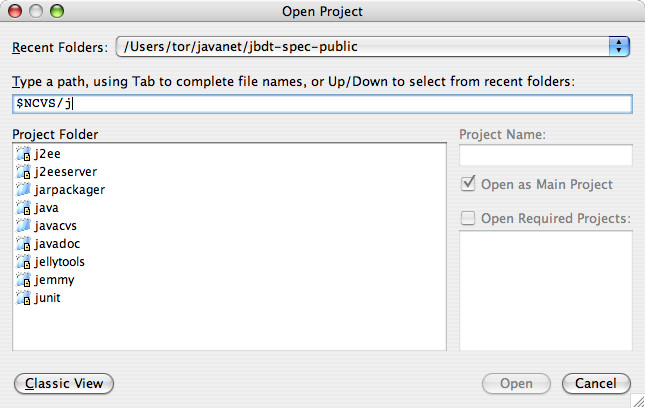
Second, I can use environment variables again! Yipee!! I've really missed this feature. I used to do all my navigation with environment variables when I was an avid Emacs user. I had defined important directory locations with environment variables. For example, $D would point to the main debugger source directory; $E the editor, and so on. I could simply hit C-x C-f to open a file, and enter the path as $D/Breakpoint.cc to open the Breakpoint class. With the Quick File Chooser, you can again embed environment variables within the path, and everything is substituted correctly.


Here's a screenshot of the plugin in action. As you can see I've typed in an environment variable to jump to my NetBeans source tree, and I've started typing a path - and all the files are filtered down to the possible matches so far:


Thank you, Jesse and Tim!


If you want to get this module, go get it from nbextras.org/. The instructions for how to connect to it via the NetBeans Update Center are here.


*: There is an unintuitive way to jump to an arbitrary directory, in some applications, by going to the Search field and starting to type a path. Provided the first character is "/", this will cause a dialog to pop up where you can type the directory. But this is not a decent workaround, because it only works for absolute paths, there's no tab completion etc. And worse yet, many applications (including NetBeans) don't include a Search button next to the directory dropdown.


Tuesday, April 4, 2006

The year 2038 Problem

WARNING: This blog entry was imported from my old blog on blogs.sun.com (which used different blogging software), so formatting and links may not be correct.


I usually never care about post dates, but the time event tonight is too symmetrical to miss:


01:02:03 04/05/06

(This is assuming the American format where the month number is listed before the day number: hh:mm:ss mm/dd/yy.)


Remember back six years ago, when "millenium babies" were all the rage? People
were trying to time it such that their babies would be born right at the turn of
the millenium (and please don't post comments about millenium starting 1/1/2001, not
1/1/2000).


We didn't schedule our kids by desired birthdates, but my middle son ended up with an interesting
birthdate anyway: 101000. Okay, I admit that the date is interesting in a very nerdy sense...


Time events like 1:2:3 4/5/6 are significant only in that they have
a nice ring to them. Just like the switch from 1999 to 2000: three digits
in the current year changed. In an absolute sense the event has no significance: it's
only a round number relative to the point we designated as time 0.
And let's not forget the historical fudging with the dates... take a look
at the source code for the GregorianCalendar class in java.util for example and
look for October 1582...
Or just cheat.


Many unix systems use a millisecond counter to represent time. The designated begin time, zero on this counter,
is January 1, 1970.
Unfortunately, when older systems that still use 32 bit integers to hold this counter
reach the magical moment when the bits all roll
over, there's the potential for Bad StuffTM to happen. Which brings me back
to another millenium craze: y2k. It was a giant flop - or a resounding success,
depending on your perspective.


When we reach the millisecond timer limit in January of 2038, however,
we've got a whole new set of challenges to look forward to: the y2.038k problem.
And perhaps, lots of IT spending and OS upgrades. (64-bit Solaris uses 64 bits for time_t and has no
year 2038 problem.) Here's
more on the year 2038 problem.


And of course, year 2038 will bring a chance for truly nerdy parents to have a child with a birthdate
of 0, when expressed in unix milliseconds, truncated to 32 bits. Take that, millenium babies!